
2 November 2023
Code, copyright and the teatime alarm
In October I was pondering two pretty serious questions: what’s happening to Twitter and what’s happening with AI.
Twitter: Should I stay or should I go?
BeMoreDigital held a webinar titled “X (Twitter) should we stay or should we go? – Explore the pros and cons of staying on Twitter and how to exit well.”
Aimed at charities and social enterprises, the event highlighted that there are (at least) three aspects to think about.
1. What’s wrong with Twitter/X
First, functionality. Every day there is another news story of changes at X that have made it harder to use. The latest is that they no longer display link text, instead showing only a preview image and the main domain name. There are some workrounds, like just posting the link twice, but they don’t help with the accessibility problems.
Second, there are ethical issues around unreliable content, lack of moderation and excessive influence.
On one level, X’s problems with getting advertisers means a lack of quality control. Fortunately, the platform’s “Community Notes” function – one of the few good things about it – has come in useful in challenging the claims in some of the less ethical ads.
A more serious issue is the lack of resources to tackle the disinformation that escalates when there’s a war on.
And questions have been raised about the way that the owner’s world view is increasingly promoted on his own platform. It may just be, as the Guardian puts it, “opinionated carelessness”. Or he could be turning into the Rupert Murdoch of social media.
2. Wanting to stay
A lot of us are emotionally attached to Twitter, or what it used to be. Only last month, I had an enjoyable day out with a friend I’d made on the platform, meeting them in real life for the first time. For years, Twitter felt like a community: a place to meet like-minded people and, yes, make friends.
From a business point of view, Twitter has been valuable as a source of information and as THE place for business networking. For a charity (or a trade union – I’m social media officer for Oxford NUJ and it’s something we’re discussing, too), it’s where you can find journalists, activists, politicians and other organisations in your field.
It is still, in the words of Elon Musk, THE “town square”. There’s a lot of value in that, and the fragmented nature of the social media competitors means that there’s nowhere else that really fulfils that function. The bottom line is that none of the other options offer what Twitter used to do and, to an extent, X still does.
3. Knowing how to go
If you decide to go, the next step is having an exit strategy to help manage the transition. As a minimum, you should be “planning to stay but preparing to leave”. There’s a good summary of the discussion on the BeMoreDigital blog.
It’s a lot to think about, and the discussion is going to run and run. Women in Journalism has just announced a panel on the subject, titled What’s Next After X?, which looks at the implications of the changes for news publishers and broadcasters.
Geek Night and AI
I used to go to a lot of meetups before covid and one of my favourites was Oxford Geek Night, so it was good to go back this month. As always the talks were informative and engaging, covering a wide range of subjects, most of them fairly accessible to non-techies like me.
I was particularly interested in the talk on Copyright and AI. I most often come across the discussion from the point of view of writers and artists, but this focused on code which was an aspect I wasn’t familiar with. The speaker from Moorcrofts LLP explained that copyright can be infringed at several stages in the process of generative AI, from ingestion to outputs. And AI-generated code can be a copyright infringement or have copyleft obligations. There’s a lot for us all to learn about this.
On the subject of ingestion, I discovered that Substack now has a setting that allows you to “Block AI training”. This setting indicates to AI tools that their models should not be trained on your published content.

That’s recently become a big issue for book writers, and the Society of Authors has published advice on how to tackle it.
Meanwhile, the Collins Dictionary has made “AI” their word of the year. Of course it has.
Plug #1: My Geek Night pitch
At Geek Night they invite attendees to do a short pitch at the end. This was mine.
“My name’s Penny Kiley, and I’m not really a geek. Well, I’m a words geek not a tech geek.
If you’ve got a website project coming up that needs some input on the content side, please get in touch. I’ve done content strategy, content design, copywriting, web editing or just helping out with migrations.
I’ve recently worked on relaunches for International Alert, Plan UK and the Bodleian Libraries. I work with nice people!
Here’s some social proof, from a recent LinkedIn recommendation: “the consummate professional – met our very tight deadline while providing a superior service – a delight to work with.”
Please give me a shout if I can help.”
Plug #2: My book chapter
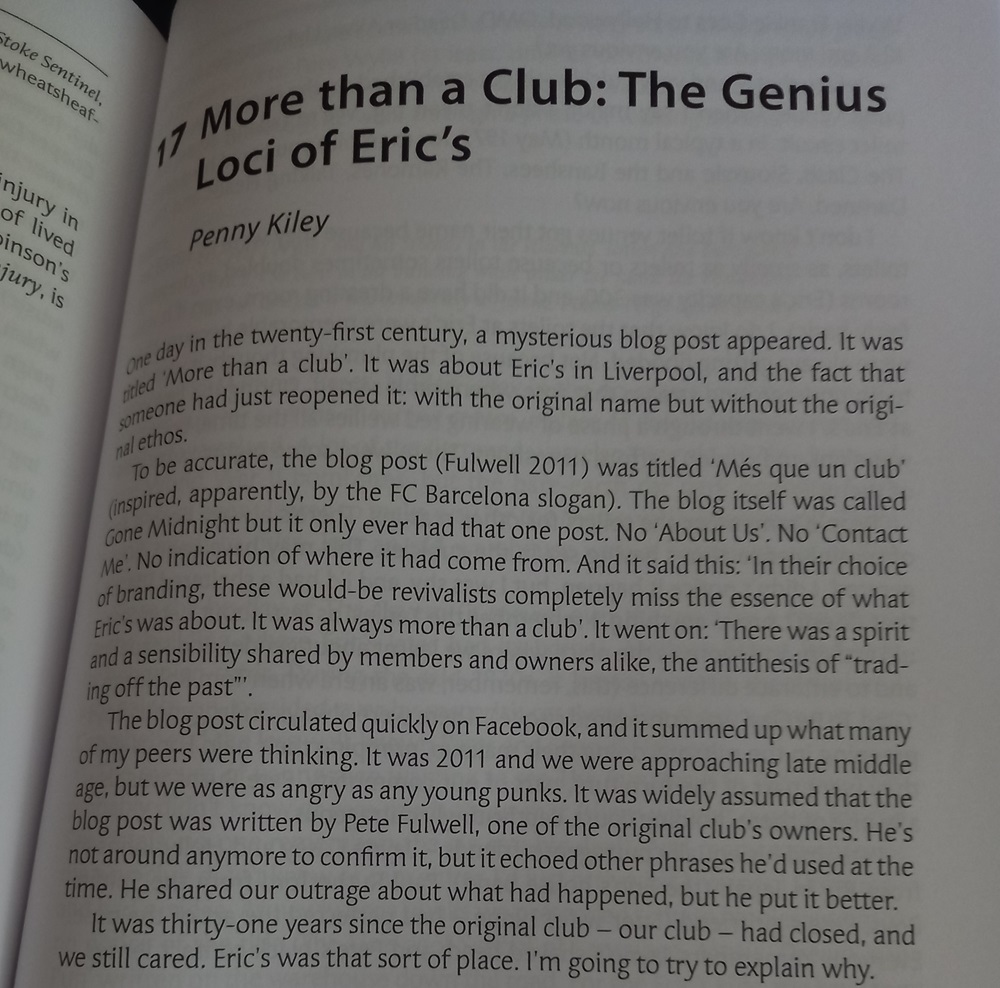
I’ve written a chapter in this book, just published. Venue Stories – Narratives, Memories and Histories from Britain’s Independent Music Spaces is edited by the Music Memoir Research Group at York St John University and I’ve written a piece on one of the best music venues ever, Eric’s in Liverpool.

Word corner
Yes, you do need proofreaders for packaging.
I discovered this month that the producers (well, marketers) of Calgon don’t know the difference between “prevents” and “protects”.

And finally
According to Know Your Meme, British TikTok users have been pranking their followers by claiming that “tea time alarms” go off every day in the UK, meaning residents have to drop everything and have a cup of tea.
“Is the British ‘Tea Time Alarm’ real?” they asked on Twitter. My response: it ought to be.